
If You Lead It, They Will Come
The myth of ‘if you build it, they will come’
The dream of starting and growing a business is one that many of us dare to dream and eventually follow through on. But it is in this dream that we sometimes fall victim to the old movie slogan of “if you build it they will come”. Any Kevin Costner fan knows that Field of Dreams was the trigger for this famous quote that gets used from time to time to imply that if you follow through on your dreams, as crazy as they seem, eventually it'll come good.
But for many people the reality is that we build our dreams, we build our businesses, and then we're left wondering why no one is coming to the party.
After working with startups for two decades, one thing that becomes clear is that if you can dream it, you can plan it, and if you can plan it, you can make it … but it is in those plans that we sometimes can lose sight of what we're actually building. A business exists to make money pure and simple. Yet this is not the motivation for most of us to start a business. We start our own enterprise because we yearn for more freedom, more creative outputs and the simple joy and satisfaction of making something for ourselves, and of ourselves. But the real challenge is that when you start a business you're really building an entity that requires a whole range of different skills that you may not have even tried before let alone even know what those skill sets are that you suddenly need to tap into.
So what are the key ingredients that draw people to your business?
Is it marketing or leadership or management or maybe as simple as a good product and good timing?
There's an argument for all of these individual aspects of running a business. Some will argue that marketing is the oxygen that drives business. Some will argue that a good product or a good service will always find a market to buy it. Some research indicates that even with the best laid plans and an excellent product or service, timing is the one element that you can't foresee and will ultimately make or break your business.
Warren Buffet knows better than most
One of the most famous investors of the 20th and 21st century was arguably Warren Buffett. He made billions investing in stocks and trading in the value of other people's businesses. One of his most famous lines for picking a good stock or business to invest in was famously “money follows management”.
In many years of working with business and observing businesses of all shapes and sizes, I have to confess that this is a highly accurate statement. I've seen some of the worst ideas come to life and turn a healthy profit simply because the person managing the business really understood the mechanics of business and how to manage it well. On the flip side, I've equally seen exceptional products and services never quite make it past the startup phase because the owner simply didn't educate themselves enough on how to manage a business. I don't think this is the business owner’s fault or failure, I simply think that managing a business involves a very wide breadth of skills and taking them all on by yourself can be a sort of maddening endeavour.
So how do we overcome this massive skill gap when we're trying to build our dreams and build it to a level that people gravitate towards us just like Kevin Costner’s ghost field? What magic can we draw from the air around us to simply make things work in our favour and learn how to holistically manage well?
When no-one’s looking
Over the years, there is one brand of magic I've seen move mountains and influence thousands of people to bend to their will and gravitate towards their dreams… making a dream into a reality. And it's this one simple thing called leadership.
But not leadership as you might know it.
Leadership is not a buzz word or a job title. Leadership is a way of thinking and acting as only a leader can. And there actually different phases of leadership, which is another aspect of business that many people don't share and talk about enough.
The very first phase of leadership is self leadership. Self leadership is not the same as being a self starter or being self sufficient or being self aware. Leading one's self is a way of being present in every aspect of our day and understanding that leadership starts with the thoughts, actions and habits that begin when no one else is looking.
Some of the worst operational managers I've come across have had the same mindset and thoughts towards their staff base and customers. It is an undeniable cause and effect that I've seen over and over again throughout my years in business where if an operations manager has negative thoughts about their staff, their staff in turn will perform extremely poorly and never feel the sense of leadership and support that they could have from a positive experience through that operational manager.
But operational managers do not start out thinking negatively about staff. They start out thinking of themselves as capable managers and expect others to fall into place around them. In fact, their thinking towards staff begins with that time before they become managers when no one else is looking. Those thoughts towards others, either positive or negative, begin like a seed planted in the earth. All the elements of their life their, career and their experiences come together, in the perfect storm that shapes their opinions of others, their actions towards others, and the habitual choices and influence they exert in their role.
If one can lead one's self with positivity, with responsibility, with open-mindedness and agility, with a sense of curiosity, and the fundamental understanding of cause and effect … this is the first phase in exceptional leadership.
Learning to lead oneself creates the perfect environment for understanding how to lead others. In the next phase of leadership where we may manage a small team, or even just one other person, the next layer to leadership is empathy and emotional intelligence. Understanding how other people think, feel, respond and regulate their emotions in a group environment creates a working culture that feeds into positive, competent leadership. And that's you.
As your team grows and develops, we move beyond self-leadership and empathising with others to creating a vision for the future. Having the skills and positive environment to lead others is only matched by having a clear vision and direction for where you are leading people to. People can only follow a leader if they're moving in a forward direction with clarity.
Learning to lead gains momentum for every part of your business
Leadership can sometimes be confused with charisma and influence. But true leadership is understanding that our thoughts create our actions, and our actions create habits, and those habits no matter how small are observed and followed by the people around us. It takes more than a winning personality and an articulate voice to truly lead well and to build a business that people want to gravitate to and follow your lead.
Leadership can be learned.
Start with your thoughts. The main ingredients of leadership thinking are:
- being clear enough on your future to choose a path
- being comfortable with making mistakes and failing
- being brave to take responsibility regardless of the outcome
- understanding that there's no such thing as ‘cannot’ but simply that there are only problems seeking solutions
- accepting that people are imperfect including one’s self
- knowing that you may not know everything
- understanding that everybody is just trying to do the best they can and sometimes to be the best they need guidance, including one's self.
These foundational thoughts allow us to take actions that always move forward in a positive, inclusive, and mature way. They permit us to make mistakes and try again and to keep seeking the information and opinions we need to solve problems even when the challenge appears to be insurmountable. It also encourages us to guide, mentor and lead others with equality towards a common goal.
Leadership forms the foundation for sustainability and growth in every aspect of your business.
If you want to build your dream business … everything can be learned, every problem can be overcome, and every staff member and client can gravitate towards your business vision. But it doesn't come with building the perfect business, it comes with creating oneself as the perfect leader, even if we are imperfect and stumble along the way.
HOW to practice self leadership
Here’s a few simple ways to build your self-leadership skills…
1. Catch negative thoughts before they become an internal conversation. The longer your inner voice dwells on the negative thought, the more connections your brain is making to solidify the idea as truth.
2. Avoid gossip…like the plague. Gossip is a way of coping with challenge, without overcoming it. When we gossip, we are externalising the issue to something outside our control…we literally turn OFF the solution-seeking part of our brain.
3. Encourage, don’t criticise. Accept and embrace imperfection, everywhere and in everyone. When we voice appreciation for intent and effort, instead of criticising the imperfections, we are acknowledging that someone tried something and lost, but we can still learn from it and support and guide the next steps.
4. Say ‘no’ with confidence. We must follow our own path and vision. When we say ‘yes’ to every opportunity and every request, we derail our path and create ambiguity. You essentially regress into building someone else’s vision.
5. Own responsibility with intent. As the manager, as the leading force, as the operational driver, you are at the helm and you are responsible for everything that follows. By owning ALL responsibility, you take control in directing how and when to steer the business vehicle down the path. This makes our brain a problem solving leader, rather than a victim of chance.
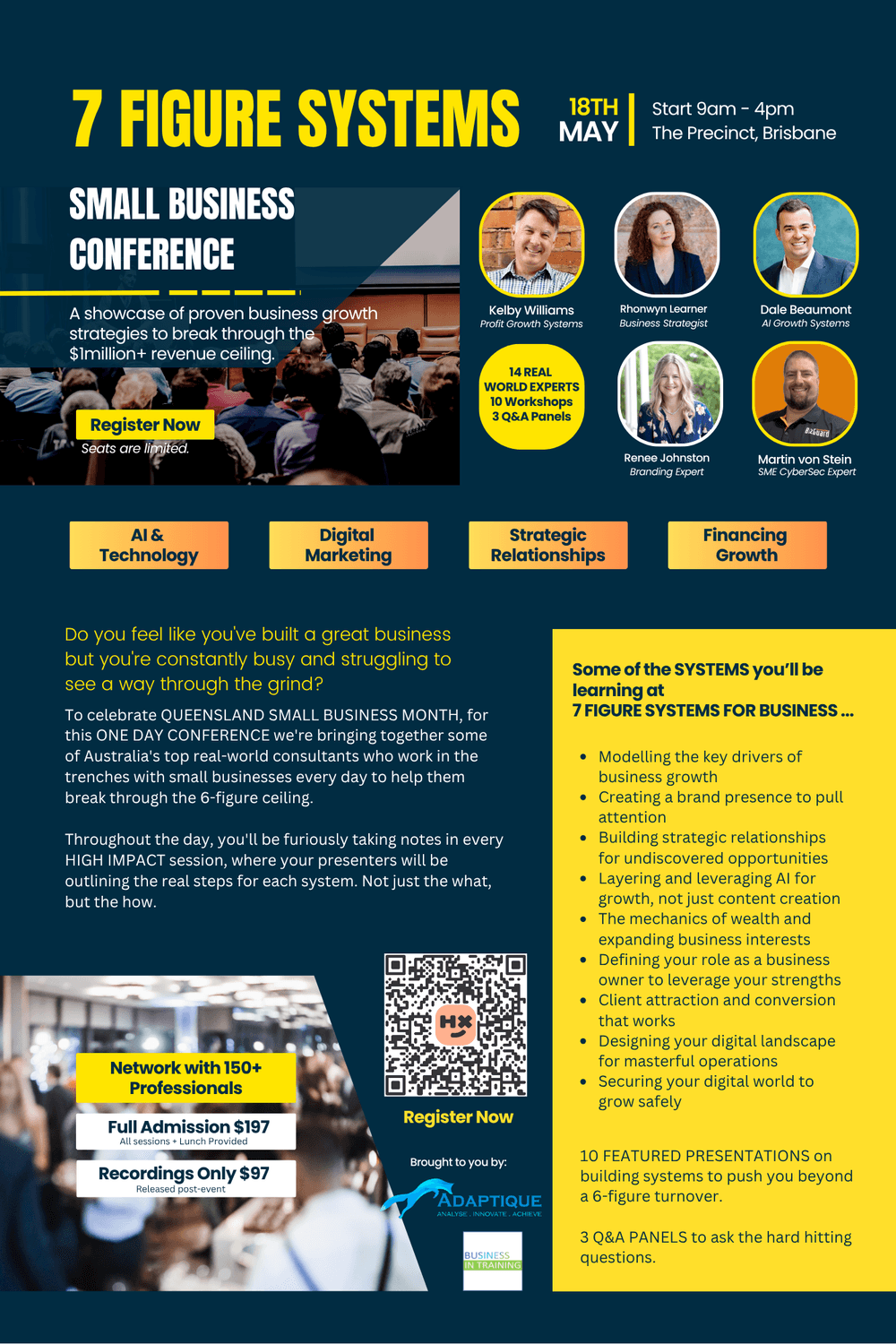
Attend the 2026 7 FIGURE SYSTEMS CONFERENCE on May 18th at The Precinct (in Fortitude Valley, Brisbane).
Go to www.7figureconference.com
to read more and book your tickets.

Rhonwyn Learner
Working with start ups for over 15 years, she is passionate about small businesses in all shapes and sizes.
Rhonwyn is an accomplished coach, consultant, trainer, author and public speaker who has worked with some of Australia's largest organisations, and some of Australia's teeniest micro businesses.
JOIN MY MAILING LIST

Website TermsPrivacy ©Business In Training 2022